 Nexora
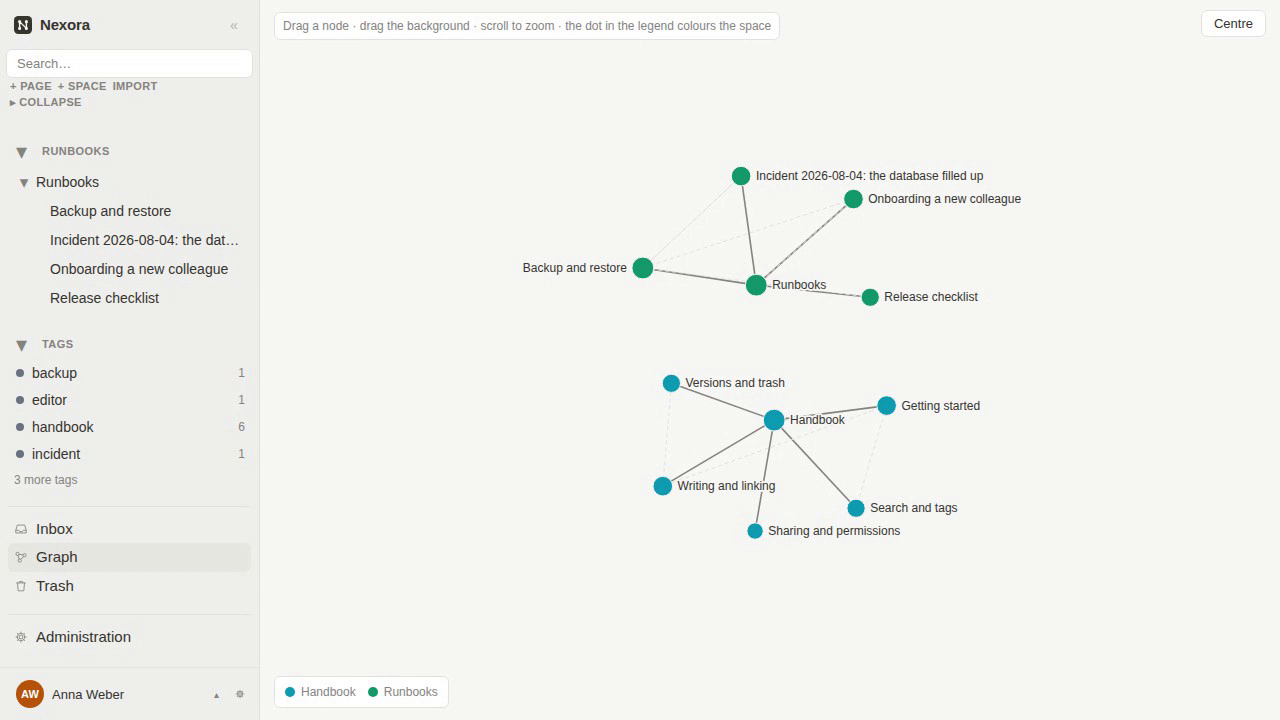
Two things the others do not have
Both come from the same idea: a wiki is worth more when it shows how its pages hang together.
Installing takes one file
Published images for amd64 and arm64, so a Raspberry Pi works too. Nothing to build, no account needed to pull them.
curl -O https://raw.githubusercontent.com/Dschonas04/Nexora/main/docker-compose.stack.yml
# change POSTGRES_PASSWORD and JWT_SECRET in it
docker compose -f docker-compose.stack.yml up -d
Open http://localhost:3000; the first account that registers
becomes the administrator. Running PostgreSQL already? Then take the
repository with docker-compose.abbild.yml and set
DATABASE_URL: the
README has both ways.
What is in it
Pages that nest
An infinite hierarchy in a collapsible sidebar, drag to reorder, autosave while you type.
Backlinks without bookkeeping
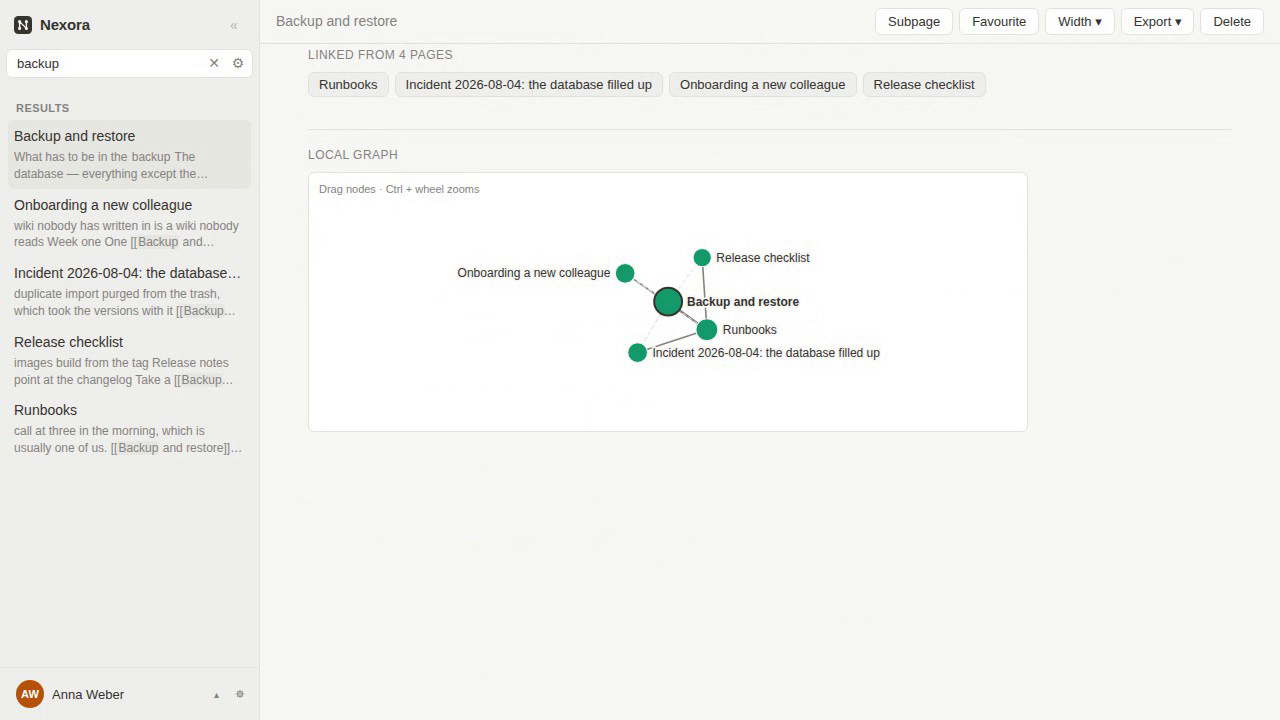
[[Page title]] links both ways. The target page lists who points at it, and the graph draws the line.
Spaces and roles
Separate areas per team or topic, opened for reading or writing per account. Anonymous access only through a share link.
Versions and a trash
A snapshot before every content change, restorable. Deleting is reversible for 30 days, then the sweep takes the attachment bytes too.
Attachments anywhere
Local disk or any S3-compatible bucket: MinIO, Garage, Ceph, AWS. With a viewer for images, PDFs and text.
The way in
Import an Obsidian vault, a Notion export, a Confluence HTML export or a folder of Markdown. A preview shows the tree before anything is created.
The way out
Markdown export of every page, free for good, because the way out must never sit behind a licence. PDF, Word and whole-space archives come with Pro.
Operating it
Two containers and PostgreSQL. Encrypted between the containers as well, backups with pg_dump, metrics for Prometheus.
It holds more than a homelab needs
Measured on one 12-core host, backend and PostgreSQL on the same machine, against 2,000 pages and 40 accounts. An operation is a user action, not a request.
Take the paper part seriously: loopback, no TLS, a database that fits in cache. What it does support is the modest claim: several hundred people working at once are unremarkable. The method is written down.
Next to the others
The short version. The long one says where each of them wins.
| Nexora | Notion | Outline | Docmost | Wiki.js | |
|---|---|---|---|---|---|
| Self-hosted | yes | no | yes | yes | yes |
| Sign in without an identity provider | yes | — | no | yes | yes |
| Knowledge graph | yes | no | no | no | no |
| Backlinks | yes | yes | yes | yes | no |
| Several people in one page at once | no | yes | yes | yes | no |
| Extra services to operate | none | — | Redis | Redis | varies |
What it is not
Better to know now than after the migration.
- No real-time editing. Two people in the same paragraph is not it: the save that would overwrite somebody is refused instead. Docmost and Outline do the real thing.
- No Notion databases. No table views, no boards, no formulas. This is a wiki, not a small application platform.
- No plugins, no AI. There are settings, not an extension interface and not an assistant writing your text.
- No OSI licence, yet. BUSL 1.1: run it in production, commercially, for free, with versions, attachments and comments included. Eight extras for larger teams need a key, and the whole thing turns Apache 2.0 on 2030-08-19. Some catalogues stop right there, and that is fair.
- No large community. It is young and mostly one person's work. Outline, Docmost and BookStack have years of issues and people who hit your problem before you.